A brief definition of Equipment Criticality Assessment
Equipment Criticality Assessment (ECA) is a structured methodology used to evaluate the importance of equipment in an industrial or operational setting. It determines how critical a piece of equipment is based on factors such as safety, production impact, financial loss, and operational reliability.
This assessment helps organizations prioritize maintenance, optimize resources, and mitigate risks by identifying which equipment failures would have the most severe consequences.
Purpose of Equipment Criticality Assessment
The primary objective of Equipment Criticality Assessment (ECA) is to enhance operational reliability by identifying essential equipment that requires proactive maintenance, ultimately preventing unplanned downtimes that could disrupt business operations.
Additionally, ECA plays a crucial role in improving safety and compliance by ensuring that critical safety-related equipment is properly maintained, thereby reducing risks and meeting industry regulations. Another key objective is optimizing maintenance strategies by distinguishing between critical and non-critical assets, allowing organizations to apply the appropriate maintenance approach—whether predictive, preventive, or reactive.
Furthermore, ECA supports data-driven decision-making by providing structured insights into asset management, guiding long-term investment decisions, and identifying equipment that requires redundancy or backup systems.
Why is Equipment Criticality Assessment Important?
The urgency of conducting an Equipment Criticality Assessment (ECA) directly impacts an organization’s operational efficiency, safety, and financial performance:
- Risk Mitigation. Equipment failures can lead to catastrophic outcomes, including safety hazards, environmental damage, and costly production downtimes. ECA helps identify which assets are most critical and at risk, enabling proactive measures to prevent failures and mitigate potential risks before they escalate.
- Resource Optimization. In industries with extensive and diverse assets, resources such as time, labor, and capital are often limited. Conducting an ECA allows organizations to prioritize maintenance efforts on high-criticality equipment. This ensures that resources are allocated efficiently, reducing waste and maximizing the return on investment in maintenance and reliability programs.
- Operational Continuity. Unplanned equipment failures can cause significant interruptions to operations, leading to lost production opportunities. By identifying critical equipment through ECA, organizations can implement targeted preventive maintenance strategies that minimize unexpected downtimes and maintain smooth operational flows.
- Long-Term Strategic Planning. The insights gained from an ECA are invaluable for strategic planning. By understanding which equipment is most critical to operations, organizations can plan for future investments, manage risks better, and ensure sustainable growth over time.
Important Aspects of Equipment Criticality Assessment
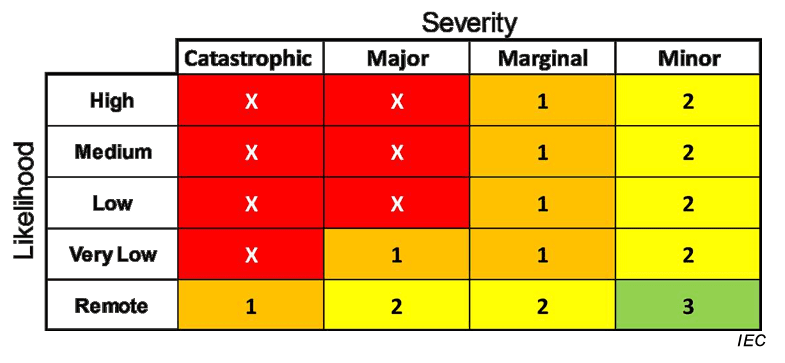
ECA often uses a risk matrix as a visual tool to assess and prioritize risks by mapping the likelihood of an event occurring against the severity of its consequences. It is a fundamental element in risk management and helps decision-makers identify which equipment poses risks above the acceptance level.
Components of a Risk Matrix:
- Likelihood (Probability): This axis represents how likely it is that a particular failure or adverse event will occur. It is often defined on a scale (e.g., 1 to 5), where a lower number indicates a rare event and a higher number indicates a frequent occurrence.
- Severity (Consequence): This axis indicates the potential impact if the event were to occur. Impact is measured on a similar scale, ranging from minor consequences to catastrophic outcomes (such as safety hazards, environmental damage, or significant production losses).
Example: Qualitative Risk Matrix Using Likelihood and Severity. The matrix is typically structured as a grid (e.g., 5x5), where each cell corresponds to a combination of likelihood and severity. Each cell is assigned a risk level—often categorized as low, medium, or high.
By placing each piece of equipment into the appropriate cell based on its evaluated likelihood and consequence, users can quickly see which risks require immediate attention. Equipment falling into high-likelihood and high-impact cells is classified as high criticality equipment.
Results from Implementing ECA
CRI has a proven track record in delivering comprehensive Equipment Criticality Assessment (ECA) services, along with a suite of reliability and safety management solutions, for a variety of high-profile projects.
Our expertise is demonstrated through our work in enhancing operational safety, optimizing asset performance, and mitigating risks for leading industry players. Below are some key projects that highlight our experience:
- Provision of Reliability & Asset Integrity, Corrosion Management Plan, Operation Readiness Strategic Assurance, and Process Safety Management for EPCI and Commissioning of the BTJT-B Wellhead Platform, infield Pipelines, and Hot Tie-In Modification for the Bukit Tua Phase 2B Development Project (End user: PT Petronas Carigali Indonesia).
- Provision of specialized services in Equipment Criticality Assessment (ECA), ITPM, and SCE for the Bukit Tua ORF project (End user: PT Petronas Carigali Indonesia).
- Execution of a Quantitative Reliability Assessment with Detailed RCM Aiming Extension (End user: PT Petronas Carigali Indonesia).
These projects reflect our capability to manage complex assessments and deliver tailored solutions that support both safety and efficiency in critical industrial operations.
Discover more insights
3 Common Asset Recording Mistakes in Oil and Gas Plants and Their Solutions

How Predictive Maintenance Prevents Offshore Equipment Failures
Understanding the Importance of an Asset Register
Explore More
Discover deeper perspectives and insights.

Explore more insights
Discover deeper perspectives from our experts.