3 Common Asset Recording Mistakes in Oil and Gas Plants and Their Solutions
In the oil and gas industry, assets are the backbone of operations. From transmitters, turbines, and pumps to thousands of meters of piping, every asset plays a critical role in ensuring safe and reliable production.
Despite this importance, asset management practices in many facilities still rely heavily on manual processes that are prone to errors. One of the most common and costly issues is inaccurate asset recording, which can lead to financial losses, inefficient maintenance, and serious safety risks.
This article discusses three common asset recording mistakes in oil and gas plants, why they are so costly, and how asset data management software can effectively address these challenges.
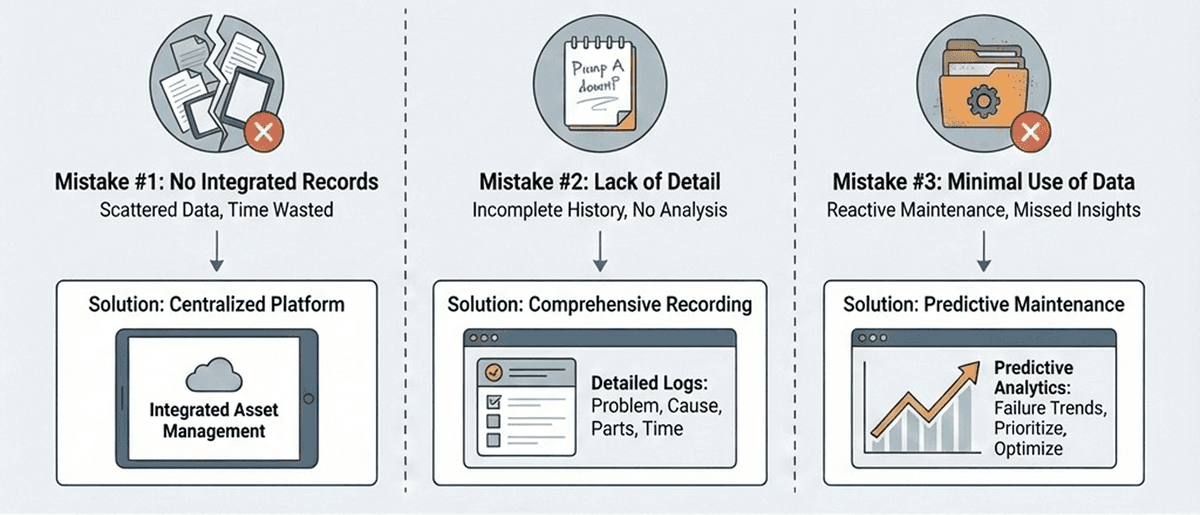
Mistake #1: No Integrated and Up-to-Date Asset Records
Asset information is often scattered across disconnected systems such as spreadsheets, paper-based documents, or even individual technicians’ personal knowledge. When maintenance teams need accurate information quickly, they are forced to search multiple sources, wasting time and increasing the risk of errors.
Implement an oil and gas asset data management application that centralizes all asset records into a single, integrated platform. Such systems consolidate technical specifications, maintenance history, and inspection records while ensuring data is updated in real time.
With centralized and up-to-date asset information, maintenance teams can access reliable data anytime and anywhere, enabling faster decision-making and reducing operational risk.
Mistake #2: Lack of Detail in Maintenance Records
Maintenance records that lack detail provide very limited value. Notes such as “Pump A repaired” or “Pump A down” fail to capture critical information, including the cause of failure, replaced components, repair duration, or associated costs.
Without this level of detail, future failure analysis becomes nearly impossible, making it difficult to improve maintenance strategies or prevent recurring issues.
Ensure that the asset data management system supports detailed maintenance recording. Technicians should be required to capture comprehensive information, including:
- Problem description
- Root cause of failure
- Repair actions performed
- Spare parts used
- Time and manpower required
This level of structured data forms the foundation of reliability engineering analysis, enabling teams to identify recurring failures and assets that require closer attention.
Mistake #3: Minimal Use of Data for Prediction
Many organizations already possess large volumes of historical maintenance and failure data. However, this data is often archived and underutilized instead of being leveraged to predict future asset behavior.
Leverage historical asset data to enable predictive maintenance and reliability analysis. Modern asset management software can analyze trends such as failure frequency, mean time between failures, and degradation patterns.
- Predict potential asset failures before they occur
- Prioritize maintenance activities based on risk and criticality
- Optimize spare parts planning and inventory levels
- Reduce unplanned downtime and maintenance costs
Closing Statement
Accurate asset records are the backbone of reliable oil and gas operations. Without integrated, detailed, and actionable data, maintenance decisions remain reactive and risk-driven.
For reliability engineers working with failure data and maintenance history, exchanging perspectives and real-world insights is often the first step toward building more robust and data-driven asset strategies.
Author : Jen Megah Bremanda Sembiring
Discover more insights

How Predictive Maintenance Prevents Offshore Equipment Failures
Understanding the Importance of an Asset Register
Understanding Equipment Criticality Assessment
Explore More
Discover deeper perspectives and insights.

Explore more insights
Discover deeper perspectives from our experts.