What is Reliability-Centered Maintenance?
Reliability-Centered Maintenance (RCM), despite the name, is not how you do maintenance. Rather, it is a systematic approach for planning maintenance programs, usually preventive maintenance and condition-based maintenance. This is done to optimize maintenance programs to have the least amount of cost by removing unnecessary maintenance, yet increasing safety by maintaining critical equipment.
When it is not implemented, asset owners usually implement the most conservative way of maintenance: manufacturer’s recommendation and time-based preventive maintenance. In the long run, this approach might not be beneficial as owners because manufacturers tend to sell things/programs, resulting in unnecessary maintenance, hence wasted time and resources.
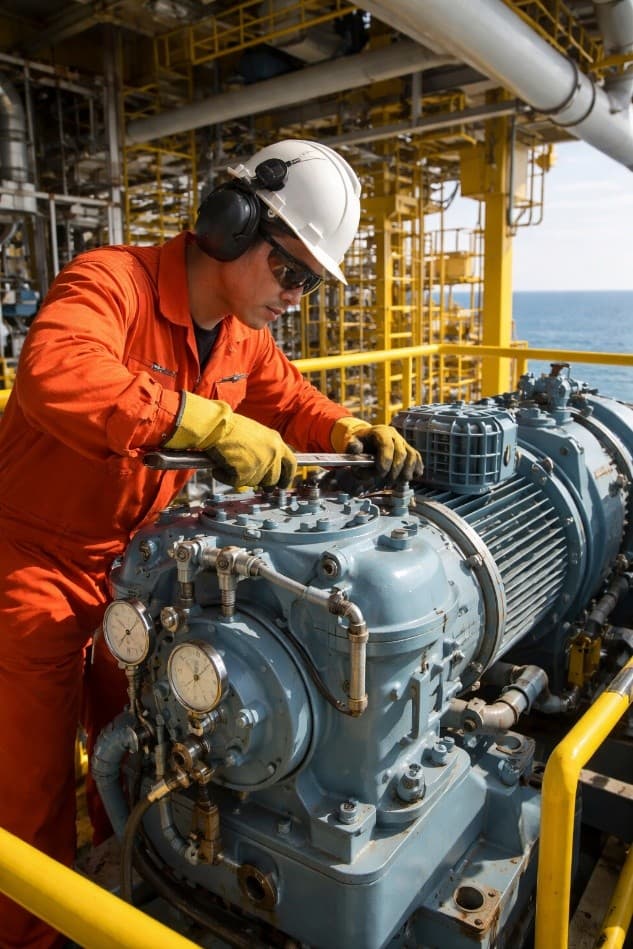
Comparing RCM to other maintenance methods such as Total Productive Maintenance (TPM) and Risk-Based Inspection (RBI) could be difficult, as they can be done together to cover different things. For example, RBI usually covers piping and mechanical static equipment such as pressure vessels and boilers. On the other hand, TPM involves every single person, including top management and field operators, in executing and supporting maintenance.
Objectives of Reliability-Centered Maintenance
Two main objectives of RCM are to remove unnecessary maintenance and increase safety by maintaining critical equipment.
As RCM mentions function, together with available data from Equipment Criticality Analysis (ECA), equipment’s function criticality can be categorized. Hence, equipment having less critical functions can get fewer maintenance activities than before. This results in more available time and resources to focus on the more critical function equipment, thereby increasing safety.
Older forms of maintenance were scheduled to protect the equipment. The newer form of maintenance is to preserve the function of equipment through RCM. Preserving function can be done in several ways, including scheduled maintenance and condition-based maintenance. Condition-based maintenance will be the driving force of optimizing maintenance programs as it will maintain equipment when needed instead of doing scheduled maintenance when the equipment is still in good condition.
Why Does RCM Matter?
Safety concerns regarding human life must be on top of every plant analysis in every industry. Every piece of equipment analyzed will have severity or consequences to safety if they fail. Even one fatality when there is a failure is high enough for the equipment to be treated differently, usually categorized as Safety Critical Equipment (SCE).
Other than that, RCM looks into the characteristics of failure. It is usually divided into three different categories:
- Wear-in
- Random failures
- Wear-out
These categories will be crucial to decide the kind of maintenance tasks needed (i.e., run-to-failure, replace, failure-finding). One exception is with wear-in, as it usually is an anomaly and production failure, so re-design or modification will be needed.
Main Elements of RCM
Main elements of RCM can be different depending on the company running it, but there are several aspects that cannot be taken out from RCM:
- Function
- Functional failure
- Failure characteristics
- Mean time between failure (or failure rate)
- Severity of functional failure
- Occurrence of functional failure
- Detectability of functional failure
Outputs of RCM
The usual output of RCM is a maintenance task or maintenance title for every equipment that is analyzed. For example, a big compressor in an oil and gas plant with high criticality might have the following tasks:
- Daily visual inspection (1D)
- Monthly oil sample (1M)
- 3-monthly preventive maintenance (3M)
- 3-yearly certification (36M)
- 80k hours overhaul (120M)
These maintenance tasks are designed to eliminate functional failures. As time passes, RCM should preferably be done again as historical data might change the probability of failure and new environmental conditions might alter consequences.
Sources
- Kim, J., & Jeong, H. Y. (2013). Evaluation of the adequacy of maintenance tasks using the failure consequences of railroad vehicles. Reliability Engineering & System Safety.
- Rausand, M. (1998). Reliability centered maintenance. Reliability Engineering & System Safety.
- Rockwell Automation & Fiix. Total productive maintenance.
- Song, M., Zhang, X., & Lind, M. (2023). Automatic identification of maintenance significant items in reliability centered maintenance analysis by using functional modeling and reasoning. Computers & Industrial Engineering.
Author: Abram Dionisius Antory
Discover more insights
3 Common Asset Recording Mistakes in Oil and Gas Plants and Their Solutions

How Predictive Maintenance Prevents Offshore Equipment Failures
Understanding the Importance of an Asset Register
Explore More
Discover deeper perspectives and insights.
Explore more insights
Discover deeper perspectives from our experts.