Geothermal Indonesia: Powering the Future Through Reliability Excellence
Indonesia stands at a pivotal crossroads in the global energy transition. As the world’s largest archipelagic nation sitting atop the "Ring of Fire," it possesses an extraordinary natural gift: approximately 40% of the world’s total geothermal reserves (Source: ThinkGeoEnergy/ Wood Mackenzie).
This article explores the current landscape of geothermal energy in Indonesia and why Reliability Engineering is the indispensable discipline required to unlock this potential.
1. The Landscape: Vast Potential, Emerging Reality
Geothermal energy is Indonesia’s "hidden green gold." Unlike coal or gas, it provides a stable, carbon-neutral supply of electricity that serves as a baseload provider.
- Total Potential: Estimated at 23,965 MW spread across 300+ locations (Source: ESDM - ebthe.esdm.go.id).
- Installed Capacity: Currently stands at roughly 2,400 MW.
- Target: The government aims to reach 3.3 GW by 2030 to meet Net Zero Emission goals (Source: RUPTL 2021-2030).
While capacity has grown, high exploration risks and massive upfront CAPEX where a single well can exceed $7 million, mean that once a plant is built, it must operate at peak performance to stay economically viable.
2. Reliability Engineering Insights in Geothermal
In the world of Reliability Engineering, a geothermal plant is one of the most complex environments to manage. It is a bridge between subsurface geological uncertainty and surface mechanical precision.
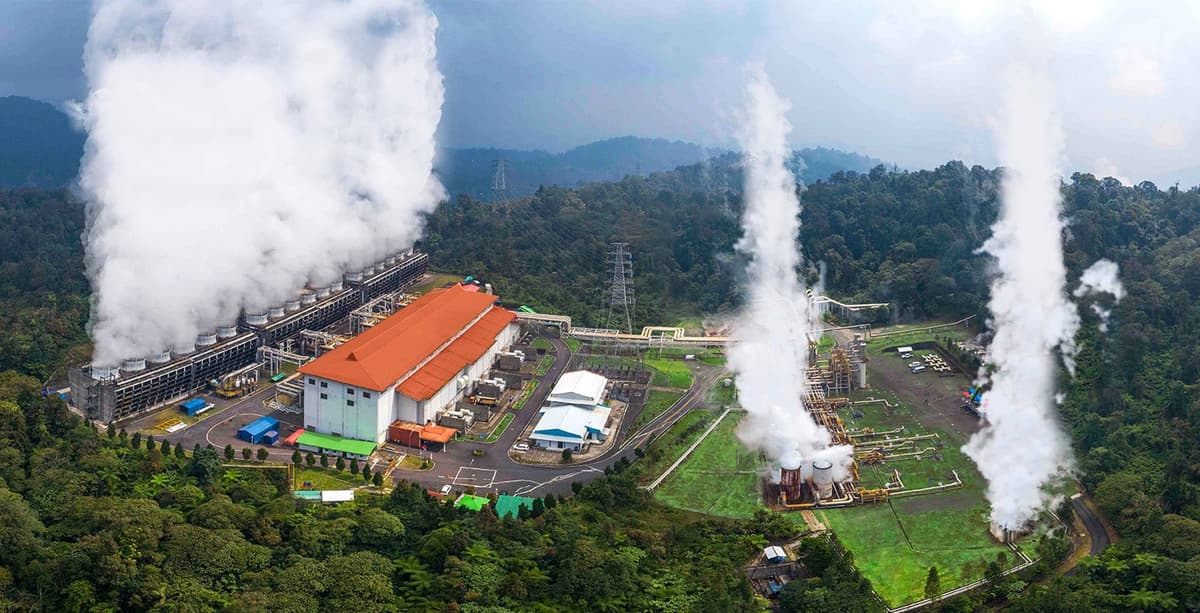
Geothermal steam is rarely "pure." It carries non-condensable gases (NCG) such as Hydrogen Sulfide (H2S) and Carbon Dioxide (CO2), along with silica and chlorides. For a Reliability Engineer, this means:
- Stress Corrosion Cracking (SCC): Constant monitoring of turbine blades and piping is required to prevent catastrophic failures caused by the chemical interaction between the steam and metal.
- Erosion-Corrosion: High-velocity steam carrying microscopic particulates can wear down valve seats and pipe elbows faster than in conventional steam plants.
Unlike a coal plant where you can simply buy more fuel, a geothermal plant's "fuel" is the reservoir. RE insights must extend to the Steam Field Management System. Reliability engineers analyze pressure drawdown and temperature declines. If the reservoir's pressure drops unexpectedly, the surface assets (turbines) may operate outside their "Best Efficiency Point" (BEP), leading to increased vibration and premature component wear.
Geothermal power plants depend on the Gas Removal System (GRS) to continuously extract Non-Condensable Gases (NCG) from the condenser. When this system fails, backpressure rises quickly, forcing the turbine to reduce load or even shut down to prevent damage to the last-stage blades.
To prevent this, reliability engineers focus on analyzing failure patterns and early signs of performance degradation. Parameters such as inter-stage pressure behavior and nozzle erosion trends are closely monitored to detect abnormalities before they affect the condenser vacuum.
3. The Urgency: Why Reliability Cannot Wait
The shift from "Maintenance as a Cost" to "Reliability as a Strategy" is now a matter of national urgency. Implementation of a focused Reliability Centered Maintenance (RCM) study has a direct impact on the following aspects:
- Maximizing Availability for Grid Stability: As Indonesia retires coal plants, the grid needs a baseload that is 100% dependable. RCM ensures the plant remains online by focusing on critical assets like the turbine and GRS.
- Protecting Massive CAPEX and ROI: With drilling costs for a single well often exceeding $7 million, any unplanned downtime is a financial catastrophe. RCM optimizes the payback period by ensuring uninterrupted revenue streams.
- Mitigating the Corrosive Clock and Asset Longevity: A geothermal facility faces a ticking clock of SCC and scaling from day one. RCM provides the data-driven roadmap to reach the full design life of the asset.
- Cost Optimization in a Competitive Market: RCM allows operators to stop over-maintaining non-critical assets, lowering the Levelized Cost of Electricity (LCOE) and making green energy more affordable.
Conclusion: The Reliability Mandate
Indonesia’s transition to a green economy depends on how reliable its geothermal assets can operate as the backbone of the power system. These systems are complex and require more than just good design; they need to perform consistently over time.
Drawing from experience in asset-intensive industries such as oil and gas, Cliste Rekayasa Indonesia brings a practical understanding of how complex systems behave and perform over time, helping ensure reliability is addressed from the outset.
Author : Jen Megah Bremanda Sembiring (Reliability Engineer)
Discover more insights
3 Common Asset Recording Mistakes in Oil and Gas Plants and Their Solutions

How Predictive Maintenance Prevents Offshore Equipment Failures
Understanding the Importance of an Asset Register
Explore More
Discover deeper perspectives and insights.

Explore more insights
Discover deeper perspectives from our experts.