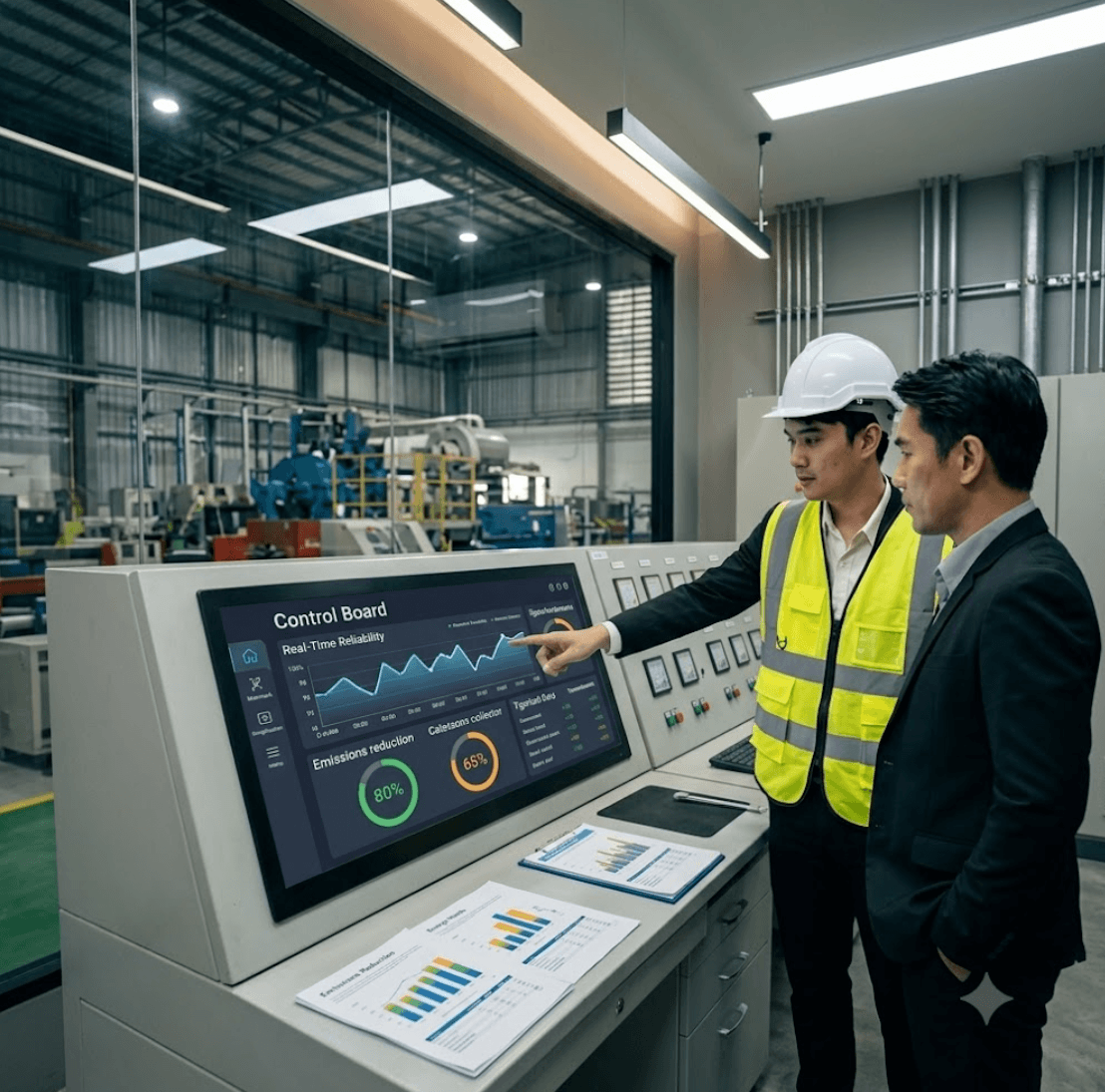
For years, reliability engineering and carbon accounting lived in completely separate silos, chasing uptime while filing compliance reports. That wall has collapsed in 2026 as Indonesia’s new carbon tax turns emissions into a direct hit on the periodic P&L. Because the assets driving these emissions are the exact same ones reliability engineers manage daily, this is no longer a future trend but something already sitting in this quarter’s numbers.
The Wake-Up Call: When Emissions Become a Direct Operating Cost
2026 changed how Indonesia's energy and manufacturing sectors think about emissions. It used to live in the HSE or CSR file, a number reported once a year and quietly forgotten. Not anymore. With the carbon tax scheme now fully in force, emissions show up as a direct cost variable, recalculated every single period.
To put it in perspective: Indonesia's carbon tax currently sits at roughly Rp30,000 (about US$2) per ton of CO2 equivalent, a fraction of what neighbors like Singapore charge, where the rate is set to climb to S$45 (around US$33.40) in 2026, and is projected to reach S$50-S$80 (US$37.10-US$59.40) per ton by 2030. That gap looks comfortable on paper. It isn't one to rely on.
The rate is floating, not fixed. By law, the carbon tax rate is set higher than or equal to the prevailing carbon market price per kilogram of CO2 equivalent, with a floor of Rp30 per kilogram if the market price falls below that. And the trajectory is already mapped out: Indonesia has a roadmap for gradually raising the carbon tax rate through the 2030s to align with global carbon pricing and emissions reduction targets. A rate that looks negligible today is built to climb, on a schedule the government has already committed to.
Industrial zones like Morowali and Batam are already feeling the pressure, racing to build internal captive renewables and Battery Energy Storage Systems (BESS) not out of goodwill, but because the cost math finally demands it.
This has created a new kind of loss that's hard to spot on a dashboard:
- The plant keeps running. Production lines don't stop. Uptime stays green.
- The profit quietly disappears. Carbon penalties accumulate hour after hour, invisible until the finance report lands.
That gap between "operationally fine" and "financially bleeding" is exactly where reliability engineering now has to step in.
A Shift That Can't Be Avoided
For decades, Reliability-Centered Maintenance (RCM) has rested on one simple idea: keep the machine running. RCM is a maintenance planning approach that ensures systems continue to do what's required of them in their present operating context, and its successful implementation leads to increased cost effectiveness, reliability, and machine uptime.
But RCM has a blind spot that's gone unaddressed for years. An RCM-specific approach that also monitors energy efficiency has essentially never been done.
This is the gap Energy-Centered Maintenance (ECM) was built to close. ECM is a maintenance concept focused on reducing energy consumption, where energy consumption excesses or energy waste are used as the primary criterion for determining maintenance or repair needs.
The numbers explain why this matters so much:
- More than 90 percent of the lifecycle cost of motor-driven machinery comes from energy, while the motor, maintenance, and installation themselves account for only 5-7 percent.
- A reliability engineer optimizing only for breakdown prevention is, by definition, ignoring 90 percent of the real cost.
A case in point. A 250 HP pump at an airport ran for nearly two years without issue, but as soon as a wireless IoT sensor was installed, an anomaly was detected within the first two weeks, caused by an improperly manufactured impeller. Once corrected, energy consumption for the pump and motor dropped by seven percent. Had this been caught two and a half years earlier, it could have saved more than $100,000 in lost energy.
That pump never "failed" by RCM standards. It just quietly burned cash for two years.
.png%3FmediaId%3Dd99f380c-ddb8-4796-88de-fb65fbb9990f&w=1920&q=75)
Anatomy of a Silent Carbon Emitter
The pattern repeats across industries with uncomfortable consistency: a component degrades, efficiency drops, emissions climb, the carbon tax bill grows. Micro-leaks in control valves, compressor inefficiency, a failed steam trap. None of it trips an unplanned shutdown, so none of it gets flagged.
From a classic RCM lens, these assets look perfectly healthy. The data tells a different story:
- When equipment operates below maximum performance, it requires additional energy to run while releasing increased CO2 into the atmosphere.
- Organizations practicing predictive maintenance achieve a minimum 10 to 30 percent decrease in energy usage, along with significant waste reduction.
- Predictive maintenance frequency shows a negative relationship with environmental impact score, confirming that more frequent predictive maintenance leads to lower environmental impact.
The takeaway is blunt: in 2026, letting this kind of degradation slide isn't a neutral choice. It's effectively volunteering to pay the carbon tax penalty, hour after hour, without anyone on the floor even noticing.
The Fix Isn't New Hardware. It's a New Set of Questions.
Most plants don't need another sensor platform to start closing this gap. They need to ask different questions about the assets they already monitor:
- Does our criticality scoring account for energy loss and carbon footprint, or 🔒Contact us to learn about the methodology!
Integrating reliability frameworks like criticality assessment with energy and carbon data has been shown to improve equipment availability, cut process variability, and strengthen environmental performance. Most reliability programs already have these frameworks in place. What's usually missing is the time, structure, and a second set of eyes to apply them consistently across a full asset base, which is exactly where outside support tends to make the difference.
Cliste Rekayasa Indonesia works with energy and manufacturing companies to rebuild criticality assessments and failure analyses around carbon exposure, design condition-monitoring strategies suited to your specific assets, and make sure today's maintenance decisions are actually protecting your margins from carbon tax risk.
Let’s Build a More Reliable Future.
Author: Jen Megah Bremanda Sembiring (Reliability Engineer)
References:
- Integrating Lean Six Sigma with Reliability-Centered Maintenance: A Unified Framework for Manufacturing Excellence - International Journal of Multidisciplinary Research and Growth Evaluation (2022)
- Energy-Centered Maintenance: Leveling Up Reliability-Centered Maintenance - Reliabilityweb (2024)
- Environmental Impact of Predictive Maintenance - International Journal for Multidisciplinary Research, IJFMR (2025)
Found this useful?
Discover more insights

The Data Behind How Global Oil and Gas Operators Build a Reliability Culture

Subsea Reliability Strategy for Indonesia's Ultra-Deepwater Gas Hubs

AI Isn't Just for Chatbots: A Case Study in Automated Screening Systems
Explore More
Discover deeper perspectives and insights.
Explore more insights
Discover deeper perspectives from our experts.