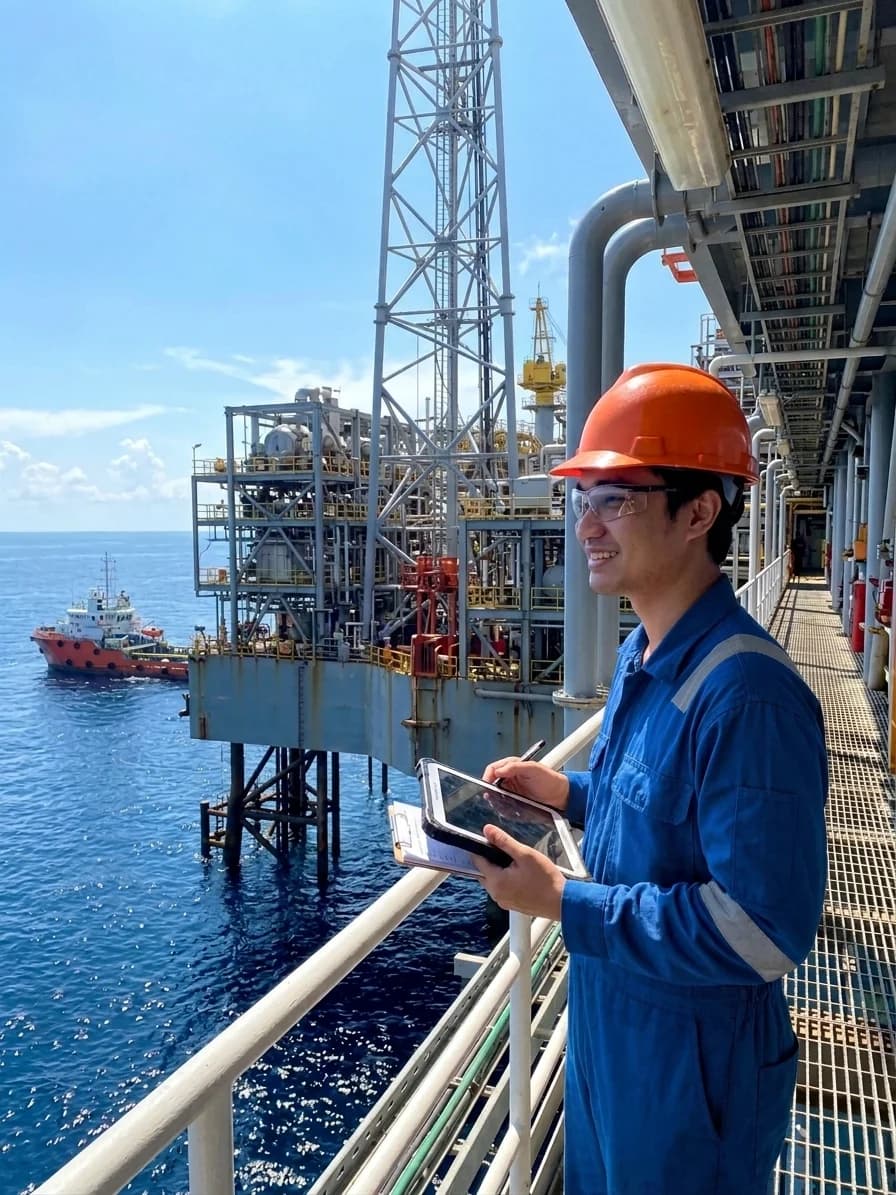
Indonesia's oil and gas sector just crossed a threshold it has never operated at before. With Eni's North Hub project in the Kutei Basin now under construction, using the Bahtera Haluan Lestari FPSO rated for water depths up to 2,000 meters, the country's subsea reliability playbook built on shallower shelf experience no longer applies wholesale. Every intervention on a subsea tree, manifold, or flowline in that depth range now costs multiples of what operators pay in the Java Sea or Natuna, and that cost curve forces a different conversation about where run-to-failure is acceptable and where it is a liability nobody can absorb.
The Cost Curve Nobody Can Ignore
Subsea intervention economics do not scale linearly with depth. A shallow-water workover might mobilize a jack-up rig and a small ROV spread for a few hundred thousand dollars a day. In water depths above 1,000 meters, the same task requires a dynamically positioned vessel, saturation or work-class ROV support, and weather windows that shrink the deeper the asset sits from shore. Industry cost studies on deepwater production systems consistently show subsea intervention day rates running four to ten times shallow-water equivalents, and mobilization alone can take weeks when no vessel is standing by in-country.
Eni's own project scale illustrates the stakes. The North Hub carries an estimated 15 billion dollar investment, with roughly 3 billion dollars in the FPSO alone, tied to combined North and South Hub resources near 10 Tcf of gas and 550 million barrels of associated condensate. A single unplanned subsea failure that idles the FPSO's processing train, rated above 1 Bcf/d, does not just cost a repair bill. It costs a share of national gas supply at a time when SKK Migas is already managing production decline against import dependence, and it costs contractual penalties tied to plateau delivery commitments running through 2029.
This is the arithmetic reliability engineers need to bring into the room before first gas, not after the first failure.
Failure Modes That Define the Risk Tiers
Deepwater subsea systems fail differently than topside rotating equipment, and the failure modes drive very different intervention economics depending on where they sit in the system.
- Wellhead and Christmas Tree Integrity. Subsea trees operate for a decade or more without direct human inspection. Valve actuator failure, seal degradation under sustained high pressure and low temperature, and erosion from sand production are the dominant failure paths. A stuck master valve can require a full workover; a failed choke can often be managed by adjusting production parameters from the FPSO without vessel mobilization.
- Flowline and Riser Integrity. Corrosion under insulation, fatigue at touchdown points, and hydrate or wax blockage inside flowlines account for the majority of subsea production losses industry-wide. These failures are rarely instant. They build over months and are the strongest argument for continuous monitoring over reactive repair.
- Subsea Processing and Control Systems. Multiphase pumps, subsea separators, and umbilical control systems introduce electronic and hydraulic failure modes that behave more like rotating equipment than static infrastructure. Redundancy design here determines whether a single component failure forces a shutdown or simply degrades throughput.
- Chemical Injection and Flow Assurance. Corrosion inhibitor and hydrate inhibitor delivery failures do not announce themselves immediately, but their downstream effect, accelerated flowline corrosion or blockage, is one of the most expensive failure categories to correct once it has progressed past early detection.
Each of these categories carries a different acceptable-risk profile, and treating them with a single blanket maintenance philosophy is where deepwater reliability programs lose money.
Building the Risk-Tiered Intervention Model
The core decision for every subsea component is whether planned intervention, condition-based monitoring, or accepted run-to-failure is the economically correct posture, and that decision depends on three inputs: consequence of failure, cost of intervention access, and the reliability of available monitoring data.
Components where failure halts production entirely, such as a subsea manifold isolation valve or a critical control umbilical, justify continuous monitoring and pre-positioned intervention plans regardless of intervention cost, because the production loss dwarfs any preventative spend. Components with redundancy built into the design, such as one pump in a multi-pump subsea boosting station, can tolerate a run-to-failure posture because a single failure degrades rather than stops output.
Diagnostic methods that support this tiering typically include:
- Permanent downhole and subsea pressure and temperature gauges feeding real-time flow assurance models
- Acoustic and fiber-optic distributed sensing on flowlines and risers for leak and corrosion detection
- Subsea control module diagnostics reporting hydraulic and electrical health continuously to the topside SCADA system
- Periodic ROV-based visual and corrosion surveys scheduled around planned vessel campaigns rather than as standalone mobilizations
- Sand and erosion monitoring at wellheads producing from unconsolidated reservoir sections
The goal is not to monitor everything equally. It is to spend monitoring budget where the cost of being wrong about failure timing is highest, and to accept known, bounded risk everywhere else.
What Operators Should Lock In Before First Gas

Reliability engineering for ultra-deepwater assets works best when it is designed into the contract structure before the FPSO ever sails, not retrofitted after startup. Operators bringing new deepwater capacity online in the Kutei Basin and similar frontier areas should secure standing vessel and ROV access agreements rather than relying on spot market mobilization, because a six week wait for a suitable vessel turns a manageable failure into an extended production outage. They should also insist that subsea equipment vendors deliver failure rate and mean-time-between-failure data specific to the operating pressure and temperature envelope of the field, not generic catalog figures, since deepwater conditions push components outside the ranges most reliability data was originally collected in. Spare critical subsea hardware, particularly control modules and choke assemblies, should be fabricated and stored onshore in Indonesia rather than ordered against lead times measured in months once a failure has already occurred. Finally, the reliability function needs a direct line into the production forecasting team, so that risk-tiered intervention decisions are made against real plateau commitments and real gas supply obligations, not against a maintenance budget considered in isolation. Indonesia's deepwater era is starting now, and the reliability decisions made in the next two years will determine whether these assets deliver their designed output or spend their first decade fighting avoidable subsea failures.
How Cliste Can Help
Cliste is ready to help operators and asset owners deepen this understanding as Indonesia's deepwater portfolio expands, working alongside reliability, maintenance, and production teams to translate the risk-tiering approach above into a plan specific to a given field's water depth, well count, and contract obligations. Our engineering team brings hands-on experience across RAM analysis, FMEA, condition monitoring architecture, and intervention planning for offshore assets operating in Indonesia's regulatory and archipelagic supply chain environment, spanning both mature shelf fields and the new generation of ultra-deepwater developments. That combination lets us move quickly from a general reliability framework to a defensible, field-specific intervention strategy that holds up in front of both engineering teams and the executives approving the budget behind it.
Let’s Build a More Reliable Future.
Author: Jen Megah Bremanda Sembiring (Reliability Engineer)
References
- Eni approves dual FIDs for Indonesia deepwater gas projects targeting 2 Bcf/d, World Oil, 2026
- Indonesia starts US$15 billion deepwater gas hub project to expand energy supply, TV BRICS, 2026
- OTC 12941 Lifecycle Cost of Deepwater Production Systems, Bureau of Safety and Environmental Enforcement (BSEE), Offshore Technology Conference
Found this useful?
Discover more insights

Flare Gas Recovery Belongs on the Maintenance Schedule, Not the Sustainability Slide Deck

The Data Behind How Global Oil and Gas Operators Build a Reliability Culture

AI Isn't Just for Chatbots: A Case Study in Automated Screening Systems
Explore More
Discover deeper perspectives and insights.
Explore more insights
Discover deeper perspectives from our experts.